Money Tips for Indians Travelling Abroad: Forex Card vs International Debit Card vs Cash

Table of Contents
- 1.Why Financial Planning Is Essential Before Travelling
- 2.What Is a Forex Card?
- 3.What is an International Debit or Credit Card?
- 4.Forex Card vs Debit Card - Purpose
- 5.Forex Card vs Debit Card - Currency Conversion
- 6.Forex Card vs Debit Card - Transaction Fees
- 7.Forex Card vs Debit Card - Safety
- 8.Forex Card vs Debit Card - Acceptance
- 9.Forex Card vs Debit Card: Which Is Better?
- 10.What is a Visa Card?
- 11.Forex Card vs Visa Card: Which is Better?
- 12.When and Why to Carry Cash
- 13.Money Management Tips for Indians Travelling Abroad
- 14.Exchange Rate & Currency Conversion Tips
- 15.Case Study
- 16.Conclusion
Are you getting ready for your international trip? Your passport is ready, your bags are packed, but how will you carry your money? Which is better for your travel, a Forex card or an international debit card, vs cash
Each one has its own advantages and disadvantages. Choosing the right option will help to save your money.
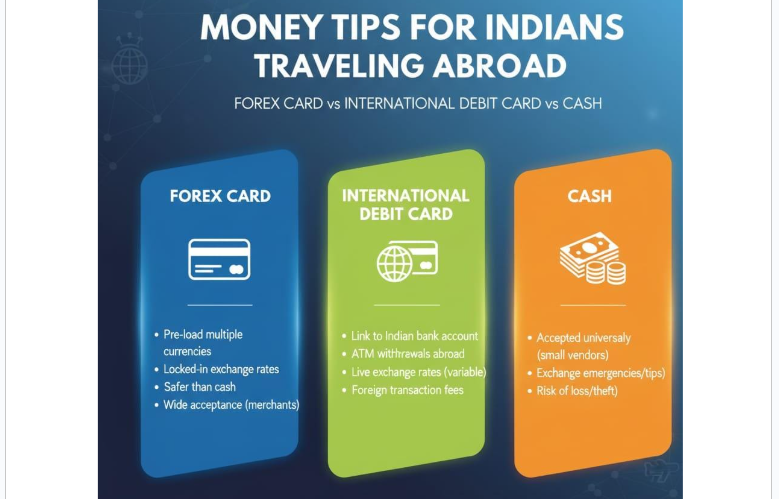
In this blog, you will get a clear comparison of a Forex card vs an international debit card vs cash to help you decide which option is best suited for your international trip.
Why Financial Planning Is Essential Before Travelling
Planning makes everything perfect; without proper financial planning will lead to draining your wallet. Abroad, the money may suddenly fluctuate and withdrawing money from an ATM may incur a huge cost for the transaction.
Having a financial plan before flying will help you manage your money efficiently and avoid unnecessary expenses.
Key Benefits of Financial Planning:
- Prevent your Card from being blocked: inform your bank about your international trip to avoid your card being blocked. Without a proper information bank, get suspicious of your international transactions.
- Avoid Unexpected Conversion Charges: Abroad, ATM transactions may cost a huge amount. Planning in advance helps you to choose the cost-effective mode of payment.
- Protect Against Theft or Fraud: carrying cash all the time with you it will be risk to safeguard. Using various payment options while carrying a small amount of cash helps reduce the chance of theft or fraud.
- Prepare for Low Digital Payment Regions: not all regions use digital payment methods that carry local currency with a card ensure that you can pay for what you have bought.
Having a clear financial plan in advance will make you aware of overspending and help to save money.
What Is a Forex Card?
In simple terms, a forex card means it is a prepaid card that can be used abroad. You can load foreign money before your international trip; it actually works the same as a debit card, but it can only be used in foreign countries. You can use this to pay at shops, restaurants, hotels, or withdraw cash from ATMs overseas. You can load currency based on your destination.
Advantages of Forex Cards:
- While comparing with a debit card or a credit card, it charges a lower transaction rate.
- If you lost a forex card, you can get a replacement one easily.
- It was equipped with secure chip and PIN technology
- This is widely popular among students and frequent travellers
- This would be a perfect choice for travelling to multiple countries
Limitations of Forex Cards:
- Some local shops usually prefer cash
- This may not work for fuel, tolls, and for certain online subscriptions
- Reloading may cause a delay if you do it while abroad.
Famous indian banks like HDFC, Axis, ICICI, and SBI provide forex cards.
What is an International Debit or Credit Card?
International debit cards mean you can make international payments to foreign countries using your Indian bank account. When you use it abroad, the money will be directly deducted from your savings account, but it may incur excess currency conversion charges.
Advantages:
- You don't need to load currency
- You can use it as a backup card if your forex card runs out of balance
- International debit cards are very convenient for emergencies or ATM withdrawals
Disadvantages:
- Withdrawing from the ATM costs a huge amount
- The card may be blocked if you don't provide any information to the bank in advance
- Higher charge for the transaction
- Banks set daily limits for international ATM withdrawals and POS transactions.
Tip: Inform your bank before making an international transaction to avoid card blockage.
Forex Card vs Debit Card - Purpose
Forex Card:
A Forex card is mainly designed to be used in foreign, so that you can load foreign currency. This payment mode is considered as more safest. It helps avoid currency fluctuation charges and often provides better exchange rates.
Debit Card:
A debit card is primarily made for domestic usage; it is linked directly to your Indian bank account, although you can make payment abroad. International usage may lead to higher conversion charges and additional banking fees, as it transacts in your native currency, which is then converted to the local currency in abroad.
Forex Card vs Debit Card - Currency Conversion
Forex Card:
If you load money into a forex card, the exchange rate gets locked at that time, which means you are protected from any future currency fluctuations during your trip.
Debit Card:
It is completely opposite to a forex card; the exchange rate varies daily, and the amount deducted from your account may differ each time when you use the card abroad. This can lead to higher and unpredictable costs.
Forex Card vs Debit Card - Transaction Fees
Forex Card:
Forexcard debits lower or zero transaction fees, and ATM transactions overseas are generally lower compared to debit cards.
Debit Card:
ATM withdrawal in abroad has a higher transaction fee, due to currency conversion charges and additional banking fees. If you make any International transactions using a debit card usually incur higher fees, typically ranging from 2% to 4% of the transaction value.
Forex Card vs Debit Card - Safety
Forex Card:
A Forex card is more safer than a debit card, as it is not directly linked to your bank account. If you lose your Forex card in abroad, you can get a replacement easily.
Debit Card:
Each transaction incurs a huge amount, highly risky because it is directly linked with your indian bank account, and it drains your account balance for each transaction.
Forex Card vs Debit Card - Acceptance
Forex Card:
Forex cards are widely accepted globally, you can use them in hotels, cafes, and ATM's. This is a convenient mode of payment for frequent travellers.
Debit Card:
Your transactions may occasionally be declined or blocked due to security concerns or detection of "suspicious activity." If you didn't inform your bank in advance.
Forex Card vs Debit Card: Which Is Better?
A forex card would be a great choice for frequent travellers, a budget-friendly option. On the other hand debit card can be used as a backup card in case of emergency circumstances, but it cannot be used as a primary mode of payment.
What is a Visa Card?
A Visa card simply means that your debit, credit, or prepaid card uses the Visa payment network. Your bank issues the card, and Visa makes sure your payments. When you use a Visa card for payment, the conversion charges and fees may incur higher costs.
Advantages:
- Visa cards are globally accepted
- Better option for emergency circumstances
- Visa cards provide fraud protection features (like OTPs and blocking options).
Disadvantages:
- It incurs higher transaction fees for ATM withdrawals (usually 2%–4%).
- Linked to your bank account (for debit cards)
- Currency conversion happens at the time of each transaction
Forex Card vs Visa Card: Which is Better?
A Forex card is a prepaid card specially designed for international travel purposes. Widely accepted payment mode.
Whereas a visa card refers to any debit, credit, or prepaid card that operates on the Visa payment network. Currency conversion happens at the time of the transaction. It is convenient and widely accepted, but typically incurs higher charges when used abroad.
In the Forex card vs the Visa card Forex card would be a great option for frequent money transactions; on the other hand Visa card can be used for emergency purposes.
When and Why to Carry Cash
Even if you carry a forex and debit card with you, you need to carry some local currency with you, because the digital payment mode is not accepted in every region, some of the local vendors prefer cash, so carrying a small amount of cash with you is essential.
Ideal for:
- It is a better option in an emergency situation, when your card doesn't work
- It is a better option to pay for taxi drivers, tipping, street shopping, and buying from local markets
Risks:
- If you lost your money, it's difficult to recover your money because there's no proof of how much you had.
- You can't get back your money if it is lost or stolen.
Avoid carrying an excessive amount of cash with you; separate your cash into two different wallets.
Money Management Tips for Indians Travelling Abroad
For Students:
- Use a forex card as your primary mode of transaction. Before departure, load currency two weeks earlier in your forex card.
- You can get a exchange cash at the airport itself, and carry some cash with you for immediate expenses.
- Open a local bank account as soon as you arrive at your destination
For Business Travellers:
- If you are visiting several countries, carry a multi-currency forex card with you.
- Avoid withdrawing from the ATM frequently; instead, use a forex card.
- Carry a visa or debit card as a backup card in case your forex card doesn't work
For Tourists:
- Use a forex card for paying for hotels, restaurants, cafes and ATM withdrawals.
- Carry cash for paying tips, sightseeing, and paying for local vendors.
- Use a debit card when your forex card is not accepted.
Exchange Rate & Currency Conversion Tips
- You can compare the money exchange rate through various apps like XE, BookMyForex, or Niyo before choosing a vendor.
- Avoid exchanging money at airports because they charge a high conversion rate; instead, you can exchange it in banks
- Request a detailed receipts whenever you exchange or load currency.
- Convert INR directly to the destination currency instead of using USD as an intermediary, as that leads to double conversion charges.
A Case Study:
Sugan, a student, travels to France to purse his higher studies. Along with him, he carries a forex card, an international debit card and some amount of cash. Despite having a careful plan, he faced debit card blockage due to "suspicious international activity"
Having limited cash with him, he worried about paying his hostel fees and buying essentials. He contacted us through the consular help desk for expert guidance. We suggested he use his forex card for immediate payment, like hostel, food and personal expenses.
As the next step, we helped him locate a reliable local currency exchange centre to avoid high airport charges, and we assisted him in notifying his Indian bank immediately to unblock his debit card. And we explained to him how to report lost or stolen money or cards, ensuring he understood how to stay secure while managing funds abroad.
Sugan was able to pay his hostel fees using his forex card, exchange a small amount of cash for daily expenses safely, and get his debit card unblocked within 24 hours.
Conclusion
Forex card vs international debit card vs cash, which suits your international trip?
The smartest way of managing money was not relying on one particular option, but having an effective strategy of using a forex card as the primary paying option, having an international debit card for emergency usage, and having cash for immediate expenses.
The best way to handle money on an international trip is to use a mix of all three. This kind of balanced approach will help to manage your money efficiently without overspending.
If you need expert guidance, feel free to contact us at the consular help desk.